

A Simple Life Visioning Framework
Start creating your life vision with this FREE Life Visioning Workbook!
Download Some Insights!
Recent Posts
Dear Gratitude,
Dam, how I have been “doing” you all wrong for so long.
We all know the extensive benefits of gratitude. From everything from reducing physical pain to improved sleep to higher levels of self-esteem.
Scholars, spiritual teachers, and scientists throughout history have waxed poetic on gratitude. And even in recent years, scientific studies have-validated its immense benefits.
Gratitude is literally good for your health.
As a deliberate practice, gratitude is the ultimate magic pill. It compounds like interest when it comes to elevating your states of happiness and attracting more of it into your life.
You may not notice the benefits immediately, but after several weeks, months, and years you will.
It’s the fertilizer for everything you want.
A timeless virtue that we all have been hearing about since we were practically in diapers.
It is the cornerstone for just about every spiritual practice and tradition. It’s a foundational principle when learning meditation, mindfulness manifesting, Law of Attraction, and even quantum physics.
Having a gratitude practice is sort of like personal growth and spirituality 101. It’s one of the first practices you adopt when you invest yourself in the journey of personal growth and one you never stop doing.
It’s the go-to tool for transformation.
No spiritual journey has ever been forged without it.
For me, have a daily, deliberate gratitude practice changed my life, as it has for many people.
When I first starting practicing gratitude I tried any and every practice. From daily journals, end of day questions, morning meditations, gratitude letters, gratitude strolls, and even scavenger hunts (yes I said gratitude strolls and scavenger hunts  ).
).
And while all of these practices were beneficial, I learned over time I was going about it all wrong.
I was missing the point.
It wasn’t the actual practices or exercises I was doing, it was the essence of gratitude that was lost on me.
While even the tiniest expression of gratitude can have positive effects and the most modest of practices is enough to change your brain, there is a higher level of gratitude.
It is what I like to call next-level gratitude — which dramatically enhances the effects and benefits of your practice.
And the key to this next-level is nuance.
It’s pure and powerful gratitude, a level that supercharges your practice.
A level you have to keep working towards, and the more you practice it, the higher it takes you.
But before we get to these nuances and how to implement them, let’s describe what next-level gratitude is not.
Below are a few of the common ways we typically experience gratitude in our life and practice — let’s call them for the sake of differentiation basic level gratitude.
While all beneficial, these are the ways we misappropriate gratitude — when it comes to understanding its genuine meaning and experiencing its true power in having a dedicated practice.
As mentioned earlier, it’s about nuance when it comes to up-leveling your gratitude practice.
While seemingly small ideas, they encapsulate what pure and powerful gratitude is.
I first was introduced to them in a talk given by Srikumar Rao a few years ago and in his book “Happiness At Work”, but it was through deliberately practicing and being aware of them that transformed my practice.
So it will take some time to experience that next-level impact.
But remember gratitude compounds like interest so the more you stay present with these ideas when you practice, the bigger the difference you will notice over time.
When applying these ideas, think of them as just two subtle tweaks or insights to be conscious of when you are about to engage in your practice.
Up until this point, we mainly focused on thinking gratitude as the primary means for engaging in a practice — which is what was termed as the basic-level.
The steps to transform your gratitude practice is going from thinking gratitude to feeling it, and then embodying it. This is the formula Joe Dispenza describes in his book Breaking the Habit of Being Yourself as the means of creating any lasting change in your life.
Thinking → Feeling → Embodying (new state of being)
Keep this formula in mind as you start to incorporate these nuances into your practice.
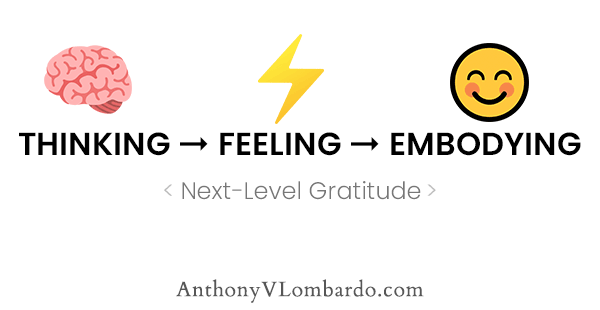
The common way most people practice gratitude especially when you are new to the idea of practicing gratitude is to merely think it rather than feeling it.
This is basic gratitude practice 101 — where you hastily write down five things in your journal you are grateful for or run through a checklist in your head right before you are about to fall asleep.
Dream job, check.
Roof over my head, check.
Family safe and healthy, check.
Gratitude doesn’t do its magic that way. When you treat your practice like creating your grocery list, it’s easy for this to become an unconscious routine like brushing your teeth and you lose out on its real power.
Remember, gratitude is an emotion like happiness and love so you have to feel it.
And yes, while merely thinking of things you are grateful for is enough to give you benefits, next-level gratitude begins with feeling it.
So head back to the formula from earlier of thinking, feeling, and embodying.
Step one to up-leveling your gratitude practice is going from thinking it to feeling it.
The limitation of merely thinking gratitude in your practice is that after all the good thoughts dissipate, you will go right back to all your worries and all things you need to attend to once you are done.
I was guilty of this for a while, simply listing out things in my head I am grateful for.
The way to stop it is to set the intention when you start your practice that you are going to focus on the feelings of being grateful and privileged.
It might at first seem difficult to do this especially if you are used to thinking (or listing) gratitude. Here are a few tips:
This will take some time but the key is to consistently feel it every day and you will notice you will be able to generate the feeling more and more.
In all the basic-level examples I mentioned earlier, did you notice a common theme?
Once you can go from merely thinking gratitude to feeling gratitude, the next-level is getting beyond the word “for”.
This is when you move from feeling grateful for something to being grateful period. This is indeed the highest level of gratitude.
It’s about making gratitude your default state of being.
This happens when you feel gratitude so frequently, you begin to embody the emotion.
The problem with being grateful for something is that whatever you are grateful for can abruptly go away. You can lose your job, break-up with your partner, or have a family member fall ill.
When you are grateful for something, the feeling is fleeting and makes your happiness contingent on external circumstances and your environment.
Striving to be grateful period is about getting beyond only being thankful and happy when good things happen to you.
It’s overcoming the pattern of expressing gratitude solely when you acquire more shit in life.
It’s setting the intention to break the habit of constantly being on the proverbial seesaw of life in which you are riding high when life is good and are down in the dumps when it’s not.
It’s about hitting pause, looking around, and taking in what’s there in the here and now. And this doesn’t include the car in your driveway, your job title, or the balance in your bank account.
This is about love for the present moment and the gift of being alive.
Here’s a quote from the Dalai Lama I repeat to myself every morning that sums this sentiment up nicely:
Waking up each day in this manner is what embodying gratitude, and “being grateful period” moves you towards.
Instead of waking up feeling overwhelmed and rushed by all that needs to get done like we typically do.
When we begin to truly understand and work towards embodying the true meaning of gratitude, you slip into the space of feeling deeply grateful not for any particular reason but just because you are deeply grateful.
And like Srikumar mentions in this video:
Far from an easy task but completely worth aspiring for.
This type of gratitude is the highest state of being that encompasses all the other attributes we desire as human beings: peace, wholeness, well-being, and love.
And we can all get there, just remember the Joe Dispenza formula:
Thinking → Feeling → Embodying (new state of being)
Once you start going from thinking about all that you are grateful for to feeling that gratitude, that feeling will compound and you will begin to embody it.
Welcome to next-level gratitude.
Start creating your life vision with this FREE Life Visioning Workbook!